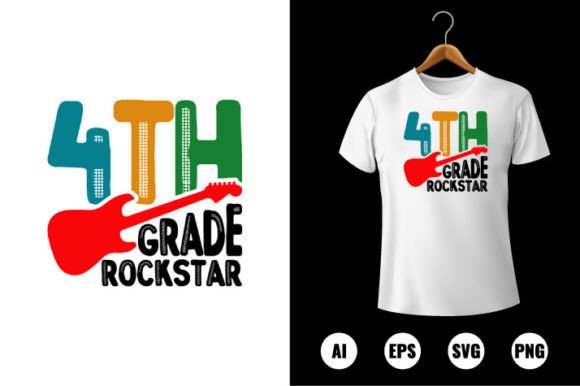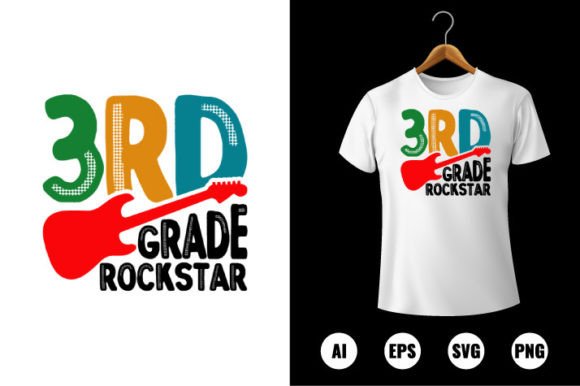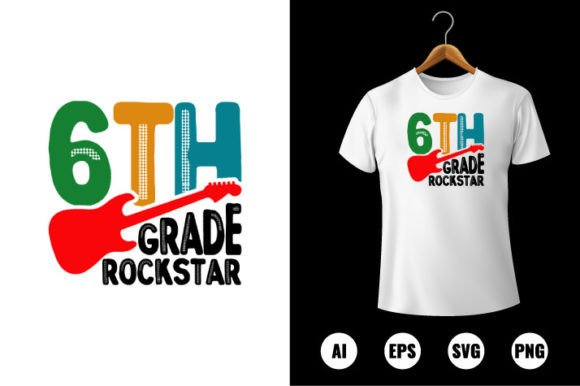
6th Grade Rockstar T-shirt Design
A 6th Grade Rockstar T-shirt Design isn’t just playful clip art—it’s a versatile, production-ready digital asset built for intentionality. Designed specifically for back-to-school use but engineered for broader application, this file set delivers strategic flexibility across print, digital, and physical media. Its value lies not in novelty, but in executional reliability: 100% vector-based, color-changeable, scalable without loss, and delivered in AI, EPS, PNG, and SVG formats—all at 300 DPI and compatible with Adobe Illustrator CC. For creators who treat design as infrastructure—not decoration—this is a tool that supports planning, consistency, and speed without sacrificing quality.
Why This Design Fits Real Workflows—Not Just Trends
Most back-to-school assets fade after August. The 6th Grade Rockstar T-shirt Design avoids obsolescence by anchoring itself in functional versatility. It’s not themed to a single year or curriculum standard; instead, it balances youthful energy with timeless visual structure—bold outlines, clean negative space, and balanced proportions that translate cleanly across t-shirts, stickers, vinyl decals, scrapbook layouts, engraved wood signs, and printable classroom décor. That adaptability means you’re not buying a seasonal graphic—you’re acquiring a reusable component in your creative system.
For small business owners running school-themed shops, educators designing spirit wear, or freelancers building client portfolios, this design reduces decision fatigue. You don’t need to commission custom illustrations for every variation. Instead, you adjust colors, layer text, resize elements, or isolate components—then deploy across multiple products or campaigns in under ten minutes. That efficiency compounds: one well-chosen 6th Grade Rockstar T-shirt Design can serve six months of content calendars, three product lines, and two grade-level promotions—without visual fatigue or brand dilution.
Strategic Use Cases Beyond the Obvious
Think beyond apparel. A 6th Grade Rockstar T-shirt Design becomes most valuable when integrated into systems—not isolated as a one-off graphic. Consider these grounded applications:
- Classroom identity systems: Teachers use the vector shapes to build consistent signage (door banners, award certificates, rotation charts) that reinforce student agency and belonging—without outsourcing design each time.
- Small-batch merch for PTA fundraisers: With editable colors and layered SVGs, volunteers swap palettes to match school colors, add grade-specific slogans (“6th Grade Rocks the Library!”), and output files ready for DTG printers or local screen shops—no designer on retainer required.
- Digital learning assets: Educators drop the PNG into Google Slides or Canva templates for interactive review games, progress trackers, or virtual “rockstar” badges—leveraging visual recognition to support motivation without extra cognitive load.
- Brand extension for edtech or tutoring services: Rather than generic stock icons, a customized version of the design—paired with consistent typography and tone—builds authentic recognition among middle-grade families who value both competence and approachability.
What to Evaluate Before You Integrate It
Even high-quality assets fail when applied without alignment to goals. Before importing the 6th Grade Rockstar T-shirt Design into your workflow, ask:
- What outcome does this serve? Is it driving enrollment? Reinforcing classroom culture? Supporting a merch launch? If the answer is vague (“It’s fun” or “It fits the season”), pause. Clarity here prevents wasted effort later.
- Does it extend—or contradict—your existing visual language? A bright, bold rockstar graphic may clash with a muted, minimalist brand. Test it alongside your current palette, typography, and imagery before scaling usage.
- Who owns the editing capability? The files are “easy to edit”—but only if someone on your team knows how to manipulate vector layers in Illustrator or convert SVGs for Cricut/Design Space. If not, budget time for upskilling or delegate edits early.
- What’s your distribution path? PNG works for social posts; AI/EPS is mandatory for professional screen printing; SVG is essential for cutting machines. Match format to function—not convenience.
Risks of Using It Without Context
Without clear purpose, even a technically excellent 6th Grade Rockstar T-shirt Design can undermine credibility. Generic use—slapping it onto every handout, slide, or shirt without thoughtful adaptation—signals low intentionality. Parents notice when spirit wear looks like an afterthought. Students sense when classroom visuals lack cohesion. And buyers scroll past undifferentiated merch faster than ever.
More concretely: using the PNG at low resolution for large-format prints causes pixelation. Assuming all colors shift uniformly across formats leads to mismatched swatches in CMYK vs. RGB workflows. Applying the design to dark garments without adjusting contrast or adding halos reduces legibility. These aren’t flaws in the file—they’re gaps between asset capability and user preparation.
How to Edit With Purpose—Not Just Convenience
“Easy to edit” doesn’t mean “edit without strategy.” Start with constraints: define your primary use case first (e.g., “screen-printed cotton tees for 6th-grade orientation day”), then work backward. Here’s how experienced users approach it:
- Color strategy: Don’t default to rainbow mode. Choose 2–3 core colors aligned with school branding or campaign messaging. Use the “100 Color Changeable” feature to test contrast ratios for accessibility—especially important for classroom posters or digital displays.
- Typography pairing: The design includes strong silhouettes and negative space—ideal for pairing with bold, readable sans-serifs (e.g., Montserrat Bold or Oswald). Avoid decorative fonts that compete visually.
- Layer discipline: In Illustrator, rename layers meaningfully (“guitar-outline,” “star-fill,” “text-placeholder”) so future edits—by you or a collaborator—are traceable and reversible.
- Scalability testing: Resize the vector to 24” wide and inspect anchor points and stroke weights. Adjust if needed—some strokes may appear too thin at large scale, others too heavy at small sizes (e.g., for enamel pin mockups).
Long-Term Value Lies in Reusability—Not Recyclability
Many digital assets get used once and archived. The 6th Grade Rockstar T-shirt Design earns long-term ROI when treated as a foundational element—not a disposable prop. One educator repurposed the guitar icon as a progress tracker: students earned “strings” as they mastered math standards. Another small business owner embedded the star motif into loyalty program cards, creating continuity between apparel and customer experience. A curriculum designer used the vector shapes to build interactive drag-and-drop activities in Nearpod—transforming static art into pedagogical scaffolding.
That kind of reuse depends less on the file itself and more on how deliberately you map its parts to real needs. Ask: Which shapes represent concepts I teach or sell? Where do my audiences encounter repetition—and how can this design reinforce recognition without monotony? When those questions drive usage, the 6th Grade Rockstar T-shirt Design stops being background noise and starts functioning as infrastructure.
Final Thought: Tools Don’t Build Strategy—People Do
No file—no matter how well-built—replaces thoughtful planning. The 6th Grade Rockstar T-shirt Design gives you precision, flexibility, and technical readiness. But its impact multiplies only when paired with clarity about audience, objective, and execution path. Use it to reduce friction—not avoid decisions. Edit it to express values—not fill space. Deploy it where consistency matters—not where novelty distracts. That’s how practical tools become strategic advantages.