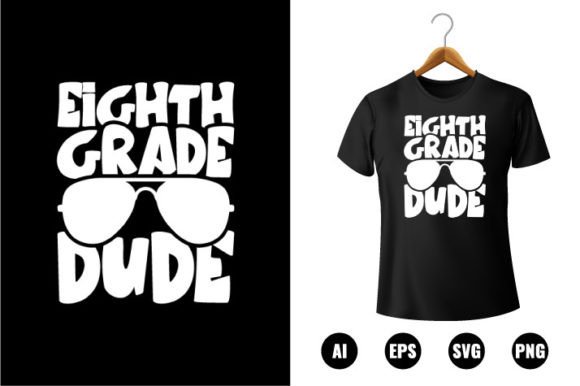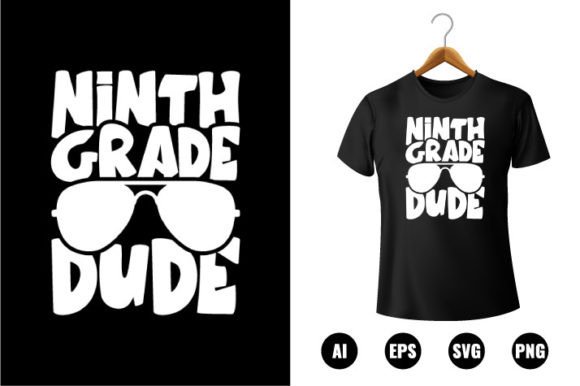
9th Grade Dude T-shirt Design: A Versatile Digital Asset for Back-to-School Creativity
Back-to-school season isn’t just about notebooks and backpacks—it’s a cultural moment where identity, confidence, and self-expression converge. Among the most visible and enduring symbols of that transition is the custom t-shirt. The 9th Grade Dude T-shirt Design stands out not as a passing trend, but as a thoughtfully engineered digital resource built for adaptability across creative workflows. Unlike static graphics or low-resolution templates, this design delivers professional-grade vector assets tailored for real-world production—whether you’re screen-printing for a school club, laser-engraving on wood signs, or designing vinyl decals for lockers.
Why Vector Flexibility Matters in Educational and Creative Contexts
At its core, the 9th Grade Dude T-shirt Design is delivered in AI, EPS, PNG, and SVG formats—each serving distinct technical needs. Adobe Illustrator (AI) and EPS files preserve full vector fidelity, meaning every curve, line, and shape remains mathematically precise at any scale. That’s essential when resizing from a 2-inch sticker to a 24-inch canvas banner without pixelation or distortion. SVG ensures web compatibility for digital portfolios or interactive classroom displays, while high-resolution PNGs (300 DPI) meet print-service requirements for DTG (direct-to-garment) or heat-transfer applications.
This multi-format approach reflects a deeper principle: versatility isn’t an add-on—it’s foundational. Educators preparing visual aids for orientation events can drop the SVG into a Google Slides deck. Small-business owners launching a local “Class of 2028” merch line can import the AI file directly into their cutting software. Even hobbyists experimenting with Cricut or Silhouette machines benefit from clean, layered vector paths—no tracing, no guesswork, no lost detail.
Real-World Applications Beyond Apparel
While the name highlights t-shirts—and yes, it performs exceptionally well for screen printing, sublimation, and iron-on transfers—the design’s utility extends far beyond fabric. Its 100% vector construction and color-changeable layers support diverse physical and digital outputs:
- Clothing & Accessories: Print on tees, hoodies, tote bags, or even baseball caps using CMYK or spot-color separations.
- Engraving & Etching: Use the crisp vector outlines for laser engraving on acrylic, wood, or leather—ideal for personalized keychains or award plaques.
- Stickers & Decals: Export transparent PNGs or SVGs for die-cut vinyl; the clean edges ensure sharp registration on laptops, water bottles, or classroom windows.
- Canvas & Wall Art: Scale to mural size for hallway displays or library bulletin boards—maintaining clarity even at 48 inches wide.
- Scrapbooking & Printable Decor: Integrate into student-made yearbook pages, welcome packets, or themed classroom borders—all editable in free tools like Inkscape or Canva.
One high school art teacher in Ohio used the 9th Grade Dude T-shirt Design as a starting point for a unit on branding and typography. Students modified colors, swapped fonts, and added personal slogans—then printed their versions on recycled cotton tees for a peer-led “Freshman Welcome Fair.” The project succeeded because the base file wasn’t locked down: it invited iteration rather than limiting it.
Editing Without Expertise: Accessibility Meets Professional Output
A common misconception is that vector editing requires years of design training. With this Back To School T-shirt Design, accessibility is intentional. Every element—text, icon, background shape—is organized into named, grouped layers. Colors are applied via swatches, not embedded fills, so changing the entire palette takes seconds: select one swatch, adjust its hue, and every instance updates automatically. There’s no need to manually recolor 17 individual shapes.
Resizing is equally intuitive. Because all components are true vectors—not rasterized effects or flattened artwork—they retain smooth curves and consistent stroke weights at any dimension. A designer working on a 12"x16" poster won’t lose legibility in the “Dude” illustration’s facial details; a parent scaling the logo down to fit a 1.5-inch enamel pin won’t see jagged edges or collapsed spacing.
That ease of adaptation supports inclusive creation. Students with limited access to premium software can open the SVG in browser-based editors. Educators using free-tier design platforms can import the PNG with transparency and layer it over photos or textures. Even non-designers—like PTA coordinators or youth group leaders—can confidently adjust colors to match school spirit themes (e.g., navy-and-gold for homecoming, neon-green for STEM week) without outsourcing to a graphic designer.
Production-Ready by Design: What “100 Print Ready” Actually Means
The phrase “100 Print Ready” isn’t marketing fluff—it describes concrete technical compliance. Each file includes proper bleed areas (where applicable), outlined fonts (so text doesn’t shift during RIP processing), and CMYK color profiles optimized for commercial printers. There are no hidden raster layers, no unembedded images, no RGB-only gradients that could shift unexpectedly on press.
For garment decorators, this means fewer prepress corrections and faster turnaround. For educators ordering bulk prints through school-approved vendors, it eliminates back-and-forth emails asking for “vector-only” or “300 DPI” versions. And for creators selling digital downloads on marketplaces like Etsy or Creative Market, it signals professionalism—buyers know they’re getting files that work, not placeholders that require troubleshooting.
Consider a small-town bookstore launching a “9th Grade Survival Kit” promotion. They used the 9th Grade Dude T-shirt Design across multiple touchpoints: embroidered patches sewn onto reusable shopping bags, foil-stamped bookmarks, and large-format window clings. All assets originated from the same AI file—no redesigns, no version mismatches, no inconsistent line weights. Consistency became effortless, not expensive.
User-Centric Considerations: Who Benefits—and How
Different users extract different value from the same set of files. Understanding those nuances helps clarify why this design resonates across such a broad audience:
- Students & Families: Gain affordable, expressive ways to mark academic milestones—without relying on mass-produced slogans or generic clip art.
- Teachers & Counselors: Use the design as a scaffold for social-emotional learning activities—customizing visuals helps students articulate transitions, goals, and belonging.
- Small Business Owners: Reduce time-to-market for seasonal collections. One apparel shop reported cutting design-to-sample time by 60% using editable base files like this one.
- Hobbyists & Makers: Enjoy freedom to experiment—changing colors, combining with other SVGs, or integrating into mixed-media collages—without licensing concerns.
- Educational Institutions: Maintain brand alignment across departments (admissions, athletics, student life) while allowing localized customization for clubs or grade-level initiatives.
Notably, the design avoids age-specific stereotypes. “Dude” reads as friendly and approachable—not infantilizing or overly casual—making it appropriate for ninth graders navigating increased autonomy and responsibility. It nods to adolescent identity without leaning into clichés, supporting dignity alongside fun.
Workflow Integration: From Concept to Physical Object
How does this asset actually move through a typical production pipeline? Imagine a community center organizing a “Rising 9th Graders” summer camp:
- Planning: Staff selects the 9th Grade Dude T-shirt Design as a unifying visual theme.
- Customization: Using Illustrator CC, they replace the default color scheme with their center’s teal-and-orange palette and add a subtle “Camp Horizon 2024” tagline beneath the main graphic.
- Output: They export SVG for digital badges, PNG for email headers, and AI for the local screen printer.
- Production: The printer uses the AI file’s vector paths to create precise screens; no redraws needed.
- Delivery: Campers receive tees, stickers, and printable goal-setting journals—all visually cohesive, all derived from one source file.
This isn’t theoretical. Real users report completing similar workflows in under two hours—time previously spent sourcing, licensing, and reworking disparate elements. The efficiency gain compounds when repeated across semesters, events, or product lines.
Looking Ahead: Sustainability and Long-Term Value
In an era where digital fatigue is real and attention spans are fragmented, longevity matters. This Back To School T-shirt Design isn’t built for one season—it’s structured to evolve. Because colors, typography, and layout are fully editable, the same file can serve as the foundation for “10th Grade Legend,” “Graduation Countdown,” or even alumni reunion merchandise with minimal effort. That scalability reduces redundant design spend and supports sustainable creative practices—reusing, refining, and repurposing instead of starting from scratch.
Moreover, the emphasis on open, standard formats (SVG, EPS) future-proofs the asset. As new tools emerge—whether AI-assisted design plugins or browser-based vector editors—these files remain compatible. They don’t lock users into proprietary ecosystems or subscription dependencies.
Ultimately, the 9th Grade Dude T-shirt Design exemplifies how thoughtful digital craftsmanship serves human needs first: clarity for educators, flexibility for makers, reliability for printers, and authenticity for students stepping into a pivotal year. It’s more than clip art. It’s infrastructure—for expression, connection, and the quiet confidence that comes from wearing (or creating) something that truly fits.