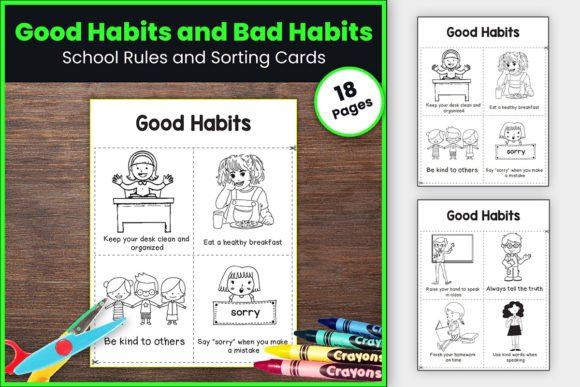
School Rules Sort Good Habits Pocket
Starting the school year with clarity, consistency, and connection sets the tone for everything that follows. For educators—especially those welcoming kindergarteners and early elementary students—the first days are pivotal. That’s where the School Rules Sort Good Habits Pocket becomes more than just a classroom tool—it becomes a shared language for behavior, respect, and responsibility.
What Is the School Rules Sort Good Habits Pocket?
The School Rules Sort Good Habits Pocket is an interactive, hands-on literacy and social-emotional learning resource designed to help young learners distinguish between positive and negative behaviors in age-appropriate, concrete ways. At its core, it’s a pocket chart activity: a set of 18 high-quality, print-ready PDF pages featuring illustrated, text-supported cards representing everyday classroom actions—like “raising your hand,” “pushing in your chair,” or “calling others names.” Students physically sort these into two categories: “Good Habit” and “Not a Good Habit.”
Unlike static posters or rote rule recitations, this activity invites participation. It turns abstract expectations into tangible choices—and gives children agency from day one.
Why Sorting Works for Early Learners
Young children learn best through doing, seeing, and talking—not passive listening. Sorting activities tap directly into foundational cognitive skills: categorization, comparison, cause-and-effect reasoning, and vocabulary development. When a first grader places “sharing materials” under “Good Habit” and explains *why*, they’re not just memorizing—they’re internalizing values, practicing verbal reasoning, and building empathy.
Research in early childhood education consistently supports active, multisensory approaches to behavioral instruction. The School Rules Sort Good Habits Pocket aligns with Balanced Literacy frameworks by integrating oral language, visual literacy, and social understanding—all while reinforcing classroom routines.
Key Features That Make It Effective
- Comprehensive, child-centered rule cards: Each card pairs simple, clear text with inclusive, diverse illustrations—no ambiguous phrasing, no culturally loaded assumptions. Examples include “walking quietly in the hallway,” “listening when others speak,” and “cleaning up after yourself.”
- Visually organized pocket chart setup: Designed for an 8.5×11-inch format, the cards fit standard pocket charts without trimming. Bold headers, consistent color coding (green for good habits, red for not-so-good ones), and ample white space reduce visual clutter—critical for neurodiverse learners and emerging readers.
- Customizable and reusable: Print on cardstock, laminate, and use year after year. Blank template cards let you add school-specific expectations (“We use our school’s kindness pledge” or “We follow the library’s quiet rule”)—so the resource grows with your classroom culture.
- Discussion-driven design: Every sorting decision opens space for conversation: “What might happen if we don’t line up quietly?” “How does it feel when someone shares their crayons?” These questions build emotional vocabulary and collective accountability.
Where and How Educators Use This Resource
The School Rules Sort Good Habits Pocket isn’t limited to the first week of school—it’s a flexible anchor across multiple contexts:
- Back-to-School Kickoff: Introduce expectations collaboratively—not as top-down mandates, but as co-created agreements. Students help decide which behaviors support learning and belonging.
- Morning Meeting Routine: Rotate one or two cards daily. Ask, “Is this something we do to keep our classroom safe and kind?” Reinforce consistency without repetition fatigue.
- Behavior Intervention Support: For students needing extra scaffolding, use the cards during small-group reflection. Pair with role-play or drawing responses to deepen understanding.
- Family Engagement: Send home a simplified version of the sorted chart—or invite families to co-create a “Home Habits” extension—to bridge school and home expectations.
Who Benefits Most—and Why
While ideal for kindergarten through third grade, the School Rules Sort Good Habits Pocket serves a broader audience:
- New teachers gain a ready-to-use, research-aligned strategy for launching classroom management—with built-in differentiation and discussion prompts.
- Special educators and interventionists appreciate the visual structure, predictable routine, and low-verbal-demand format—ideal for students with language delays, ADHD, or autism.
- Paraprofessionals and aides can lead the activity independently, supporting inclusion without requiring lesson planning.
- School counselors use it during classroom guidance lessons to introduce concepts like self-regulation, empathy, and respectful communication.
Real-World Impact: A Teacher’s Perspective
In Ms. Alvarez’s bilingual second-grade classroom, the School Rules Sort Good Habits Pocket became her “behavior compass.” On Day 2, she introduced five cards—including “using kind words” and “cutting in line.” One student hesitated over “talking during story time.” Instead of correcting, Ms. Alvarez asked, “When do we listen closely? When do we share ideas?” The class negotiated a nuanced distinction: “We listen with our ears during read-aloud—but we raise our hand to share thoughts after.” That moment didn’t just clarify a rule; it modeled critical thinking and democratic dialogue.
By Week 4, students were requesting to add new cards—“helping a friend tie their shoe,” “asking before borrowing”—demonstrating ownership far beyond compliance.
Practical Considerations and Realistic Expectations
Like any effective teaching tool, the School Rules Sort Good Habits Pocket works best when paired with intentionality—not isolation.
- It’s not a fix-all: Sorting cards won’t replace relationship-building, consistent follow-through, or restorative practices. It’s one piece of a larger behavior-support ecosystem.
- Time investment pays off: Initial setup takes 15–20 minutes (printing, cutting, laminating). But once prepared, it’s ready for daily 5–10 minute interactions—no prep needed.
- Adaptation matters: Some students may need sentence frames (“This is a good habit because…”), peer modeling, or audio support. The PDF’s clean layout makes modifications easy—just add speech bubbles or symbols.
- No bleed, high-res PDF means reliable printing: Whether using a school copier or home printer, colors stay vibrant and text remains crisp at 8.5×11 inches—no scaling or cropping required.
Is This Right for Your Classroom?
Ask yourself:
- Do I want students to understand *why* rules matter—not just *what* the rules are?
- Do I value opportunities for oral language development alongside behavior instruction?
- Do I prefer resources that grow with my students—not expire after September?
- Am I looking for a tool that supports inclusion, not just compliance?
If you answered “yes” to any of these, the School Rules Sort Good Habits Pocket fits—not as a quick fix, but as a thoughtful, sustainable practice. It doesn’t assume prior knowledge. It doesn’t overwhelm with complexity. It meets children where they are: curious, capable, and ready to belong.
Because great classrooms aren’t built on perfect rules. They’re built on shared understanding—one sorted card, one thoughtful question, one kind choice at a time.