First Grade Kickoff: Engaging Start
Walking into a first-grade classroom on Day One is equal parts exhilarating and overwhelming—for teachers and students alike. The energy is high, attention spans are short, and the need for structure, warmth, and intentionality is immediate. That’s where First Grade Kickoff Engaging Start makes a tangible difference—not as a decorative add-on, but as a purpose-built, print-ready foundation for meaningful learning from hour one.
Why Print-Ready Clarity Matters in Real Classrooms
This isn’t just another digital download. Every page of the First Grade Kickoff Engaging Start pack is sized precisely to 8.5 × 11 inches—standard letter size—and delivered in three universally compatible formats: PDF (two versions), JPG, and PNG. Why does that matter? Because it eliminates guesswork during prep week. No resizing, no cropping, no “will this fit my printer?” uncertainty. You open the file, click print, and get crisp, high-resolution output—every time. That reliability saves educators 45–90 minutes per grade level when prepping welcome materials, certificates, and independent activity stations.
The 33-page set includes zero bleed—so nothing gets cut off on standard printers or copy machines. That’s especially helpful for schools with older equipment or teachers printing at home. And because each resource exists in all three formats, you’re covered whether you need editable layers (PNG), quick-print PDFs, or web-friendly JPGs for digital learning logs or parent newsletters.
What Students Experience—And Why It Works
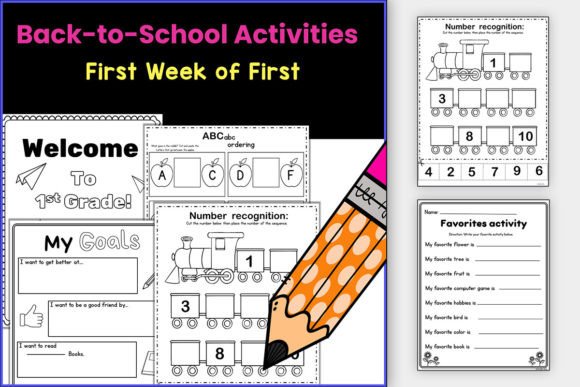
Children don’t learn best through passive observation. They learn by doing, choosing, creating, and reflecting—all while feeling seen. The First Grade Kickoff Engaging Start pack supports that naturally. Consider the six distinct “Welcome to First Grade” sheets: not generic clipart greetings, but warm, inclusive illustrations paired with simple, affirming language (“You belong here,” “Your ideas matter”). Teachers report students linger over these pages during morning arrival—pointing, naming, smiling—before instruction even begins.
Then there’s the *Heart Word Find and Color* activity. It’s not just a word search. It targets high-frequency sight words embedded in heart-shaped patterns, inviting fine motor control (coloring within curved lines) and early phonemic awareness (noticing initial sounds while scanning). Paired with the *Phonics-Based Medial Sound Review*, it becomes part of a cohesive literacy launch—not isolated worksheets, but connected practice.
Time-Saving Design, Not Just Time-Filling Tasks
Independent doesn’t mean unguided. Each of the 33 pages has been developed with scaffolding in mind. The *Reflection Booklet*, for example, uses sentence stems (“Today I tried…”, “One thing I’m proud of…”), illustrated prompts, and space for drawing—making metacognition accessible to emerging writers. Similarly, the *Book of Colors* integrates color vocabulary, descriptive language, and tracing practice without requiring teacher modeling for every step.
That intentional design means students stay meaningfully occupied for 15–20 minutes while you meet with small groups, assess baseline skills, or support transitions. One first-grade teacher in Austin used the *Count, Match, and Color* activity during her “quiet choice time” and noticed fewer redirections and more sustained focus—especially among students who typically disengage during whole-group math instruction.
Flexibility Built In—Not Added Later
The variety isn’t arbitrary. Six welcome sheets let you rotate based on class composition or mood. Five First Day certificates accommodate different recognition styles—some highlight effort, others kindness, others joyful participation. Three goal-setting options reflect developmental nuance: one uses visuals only, one pairs icons with short phrases, and one introduces simple written goals (“I will raise my hand”), letting you match the tool to individual readiness—not grade-level assumptions.
This flexibility matters most for educators supporting diverse learners: English language learners benefit from the visual-heavy options; students with executive function needs thrive with the structured reflection prompts; and neurodiverse learners often gravitate toward the tactile predictability of the *Alphabet Recognition and Ordering* activity, which uses clear sequencing cues and minimal text.
Who Benefits Most—and When to Pause and Plan
First Grade Kickoff Engaging Start serves teachers most directly—but its value ripples outward. Paraprofessionals use the *Student Favorites* activity to build rapport quickly. Intervention specialists adapt the *Number Sequence Recognition* sheet for targeted number sense work. Even school counselors incorporate the *Goal-Setting Sheets* into social-emotional learning rotations.
That said, it’s not a full curriculum replacement. It’s a launchpad—most effective when used intentionally across Days 1–5, then layered with ongoing instruction. If your school uses a specific phonics program (e.g., Fundations or Orton-Gillingham), treat the medial sound review as reinforcement—not introduction. Likewise, the *Heart Word Find* aligns well with Dolch or Fry lists, but isn’t designed to teach new vocabulary in isolation.
For homeschooling families or tutors, the pack shines in consistency: same size, same look, same flow across activities helps establish routine without constant reinvention. But if you’re working one-on-one with a child needing intensive sensory input, consider pairing these printables with hands-on manipulatives—like magnetic letters for the alphabet activity or counters for the counting pages—to deepen engagement.
A Thoughtful Alternative to “More Worksheets”
In an era of resource overload, what sets First Grade Kickoff Engaging Start apart is its coherence. These aren’t 33 disconnected pages—they’re 33 interlocking pieces of a single, human-centered strategy. The *Interactive Alphabet Recognition* activity primes for the *Phonics-Based Medial Sound Review*. The *Book of Colors* builds vocabulary that reappears in the *Reflection Booklet*. Even the celebratory certificates echo language from the welcome sheets (“You’re ready,” “We’re glad you’re here”).
That cohesion reduces cognitive load—for teachers designing routines and for students navigating new expectations. It also means less mental energy spent switching contexts, and more energy invested in connection, curiosity, and confidence. As one veteran educator in Portland put it: “It’s the difference between handing out busywork and handing out belonging.”
If your goal is a first week that feels grounded, joyful, and academically honest—not frantic, fragmented, or overly scripted—First Grade Kickoff Engaging Start delivers practical support where it counts: in your hands, on your desk, and in your students’ hands on Day One.