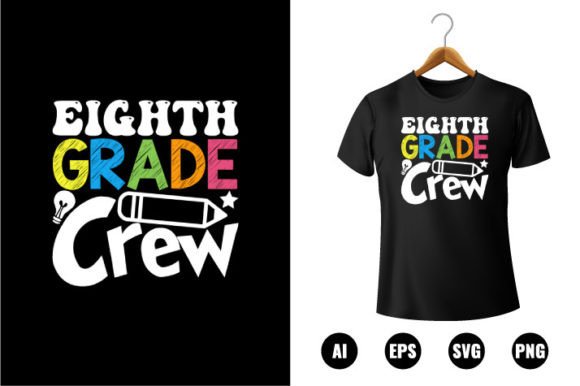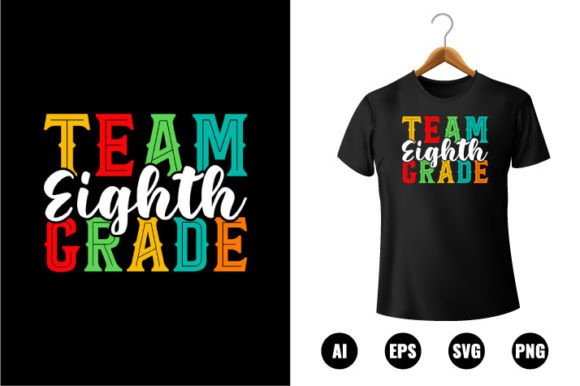
Team 8th Grade T-shirt Design
A well-executed Team 8th Grade T-shirt Design isn’t just a back-to-school novelty—it’s a tactical visual asset with measurable utility across education, small business, creative production, and community engagement. When sourced as a professional digital clip art package—complete with AI, EPS, PNG, and SVG formats, 300 DPI resolution, vector scalability, and full color editability—it becomes a flexible foundation for consistent, on-brand communication. Its strategic value lies not in aesthetics alone, but in how efficiently it supports planning, execution, and alignment across real-world workflows.
Why This Design Fits Real Operational Needs
For educators organizing grade-level events, small business owners launching school-themed merchandise, or freelance designers building client-ready templates, the Team 8th Grade T-shirt Design delivers immediate leverage. Unlike static raster graphics, its vector-based structure means no quality loss when scaling from a sticker to a banner—or adapting it for embroidery, vinyl cutting, or screen printing. The inclusion of Adobe Illustrator CC compatibility ensures seamless integration into professional design pipelines. And because every element is individually selectable and color-changeable, customization isn’t a time-intensive rework—it’s a targeted adjustment aligned with existing brand palettes or event themes.
This matters most when speed, consistency, and fidelity are non-negotiable: think PTA fundraisers needing coordinated apparel in under two weeks, homeschool co-ops preparing welcome kits, or print-on-demand sellers updating seasonal collections without commissioning new artwork each time.
Strategic Use Cases Beyond Apparel
While marketed as a back-to-school t-shirt design, the underlying file set functions as a modular visual system. Its utility extends meaningfully into adjacent applications:
- Clothing & Merchandise Production: Print-ready files eliminate prepress delays; SVG and EPS formats integrate directly into cutting software for heat transfer or DTG workflows.
- Classroom & Event Branding: Resize elements to create matching posters, name tags, slide headers, or digital announcements—all maintaining typographic and iconographic cohesion.
- Scrapbooking & Printable Decor: PNG transparency layers allow clean compositing over photos or textured backgrounds; SVG paths support laser-cut paper or wood accents for bulletin boards or graduation displays.
- Digital Content Creation: Use isolated vector shapes as UI icons, social media story elements, or animated assets (via Lottie or After Effects) for school newsletters or parent outreach campaigns.
The key insight? This isn’t a one-off graphic—it’s a reusable component in a broader content architecture. When treated as such, it reduces redundant design labor and strengthens visual continuity across touchpoints.
Planning Your Implementation Intentionally
Adopting the Team 8th Grade T-shirt Design without clarity on goals introduces avoidable friction. Before importing files into your workflow, ask three practical questions:
- What outcome do I need to enable? Is it faster turnaround on custom orders? Consistent branding across a multi-stakeholder initiative? Reduced dependency on external designers? Align the asset’s use to that objective—not the other way around.
- Who is the primary user of the final output? A teacher distributing shirts to students needs durability and wash-fast ink specs; an Etsy seller requires layered, transparent PNGs for mockup integration; a marketer may prioritize SVG for responsive web banners. Tailor your export choices accordingly.
- What systems will this touch? Verify compatibility with your printer’s RIP software, your Cricut/ Silhouette firmware, or your e-commerce platform’s upload requirements. Not all SVGs behave identically across tools—test one file first.
One overlooked but high-impact step: rename layers in Illustrator before editing. Clear labels (“grade-number”, “star-icon”, “border-outline”) accelerate future revisions and make collaboration smoother if others access the file later.
Risks of Context-Free Adoption
Using the Team 8th Grade T-shirt Design without anchoring it to purpose carries quiet operational costs. Generic application—slapping the same layout onto every shirt, sticker, or handout—can dilute messaging, confuse audiences, or unintentionally misrepresent values (e.g., using playful typography for formal award certificates). More concretely, unedited color schemes may fail accessibility standards (insufficient contrast), and unchecked scaling can distort proportions in embroidery digitizing.
Also consider licensing scope: while the package permits commercial use, verify whether derivative works (e.g., heavily modified versions sold as new designs) fall within permitted terms. Misalignment here risks legal exposure or platform takedowns—especially relevant for creators selling on Redbubble, Teespring, or Shopify.
Making Color, Scale, and Structure Work for You
The “100 color changeable” feature isn’t just about swapping hues—it’s about reinforcing hierarchy and intent. For example:
- In a classroom setting, assign specific colors to roles: navy for teachers, teal for student leaders, gold for honor roll recognition. This creates instant visual literacy during large-group activities.
- For merchandising, use color shifts to denote product tiers—black for standard shirts, heather gray for premium blends, or pastel variants for sibling packs—without redesigning layouts.
- When adapting for accessibility, replace default bright yellows with WCAG-compliant alternatives (e.g., #4CAF50 green or #2196F3 blue) while preserving shape integrity.
Similarly, “100 vector shapes re-sizable” enables intelligent adaptation—not just zooming, but thoughtful repurposing. Extract the badge icon to use as a watermark on digital report cards. Convert the border motif into a repeating pattern for notebook covers. Detach the grade number to layer over yearbook photos. Each action leverages the asset’s structural intelligence rather than treating it as a flat image.
Long-Term Value Through Systematic Reuse
The highest ROI from the Team 8th Grade T-shirt Design emerges over time—not per project, but across cycles. Schools reuse it annually with updated year dates and staff names. Small studios build libraries of variations (e.g., “8th Grade Science Edition”, “Band Boosters Version”) using the same base files, cutting design time by 60–70% per iteration. Educators archive adapted versions for district-wide adoption guidelines, ensuring alignment without central oversight.
This compounds when paired with documentation: keep a simple internal log noting which version was used where, what edits were made, and why. That record transforms a single purchase into institutional knowledge—supporting onboarding, audits, or scalability planning.
Final Strategic Note
Great tools don’t guarantee great outcomes. The Team 8th Grade T-shirt Design succeeds when matched to clear objectives, tested in real environments, and maintained with intention. It’s not about having more assets—it’s about having the right asset, in the right format, applied with disciplined focus. Whether you’re outfitting a homeroom, launching a micro-brand, or streamlining a creative service offering, treat this design not as decoration, but as infrastructure: reliable, adaptable, and quietly powerful when used with purpose.