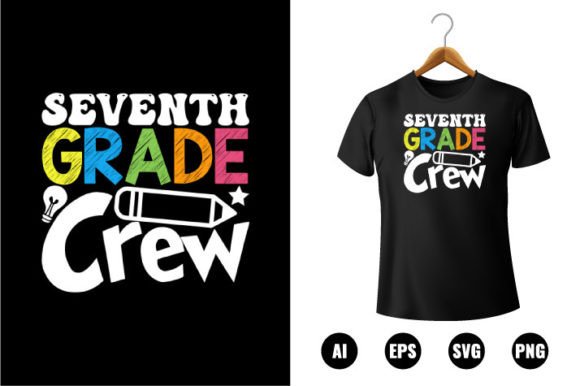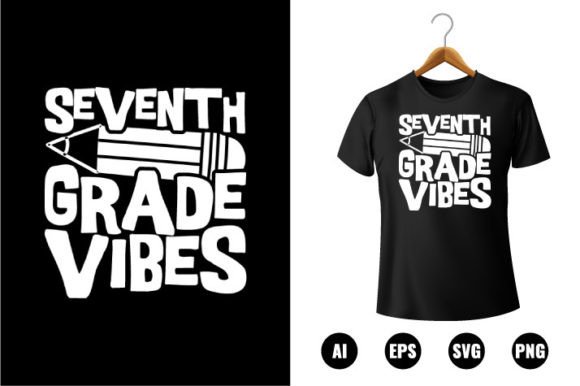
7th Grade Vibes T-shirt Design
The 7th Grade Vibes T-shirt Design is a ready-to-use digital clip art resource tailored for educators, parents, small-batch apparel creators, and crafters who need flexible, school-themed graphics—especially around back-to-school season. Unlike generic cartoon fonts or stock illustrations, this design carries a specific tone: approachable, age-appropriate energy that reflects the transitional spirit of early adolescence—neither overly childish nor prematurely mature. It’s not just a visual; it’s a contextual tool built for real-world application across multiple physical and digital mediums.
What Sets This Design Apart
At its core, the 7th Grade Vibes T-shirt Design delivers practical versatility through format depth and technical readiness. You receive four file types—AI, EPS, PNG, and SVG—each serving distinct production needs. The AI and EPS files preserve full vector integrity for professional screen printing or embroidery digitizing. The SVG works seamlessly with Cricut, Silhouette, and other cutting machines. The PNG includes transparent backgrounds and 300 DPI resolution, making it suitable for high-quality direct-to-garment (DTG) printing or printable classroom decorations.
Crucially, all vector elements are fully layered and labeled in Adobe Illustrator CC. That means colors can be changed in seconds—not just swapped globally, but adjusted per shape or text block. Need to match school colors? Swap navy for maroon and gold for teal without losing fidelity. Want to isolate the “7th” numerals for a sticker sheet while keeping the “Vibes” script intact for a tote bag? That’s possible because every component is a discrete, re-sizable vector shape—not flattened raster art or embedded images.
How It Compares to Other School-Themed Digital Assets
Many school-themed clip art packs prioritize quantity over adaptability: dozens of isolated icons (backpacks, apples, rulers), but little cohesion or typographic intention. Others lean heavily into cutesy aesthetics unsuitable for middle-grade students—or conversely, adopt minimalist corporate styles that feel emotionally disconnected from classroom life. The 7th Grade Vibes T-shirt Design occupies a middle ground: designed with intentional typography, balanced negative space, and subtle texture cues (like soft shadowing or hand-drawn line weight variation) that suggest authenticity without sacrificing print clarity.
Compared to editable Canva templates or free SVG downloads, this design offers greater control and scalability. Free resources often embed fonts as outlines or lock layers, limiting customization. Some lack color separation guidance, causing issues when prepping for multi-color screen prints. In contrast, the 7th Grade Vibes T-shirt Design includes clean, separated paths and clearly named swatches—making color separation straightforward for print shops or DIY users familiar with basic Illustrator workflows.
Real-World Use Cases and Practical Fit
This design excels where consistency, speed, and adaptability intersect. For example:
- A PTA organizing a 7th-grade orientation event might use the SVG version to cut vinyl for custom water bottles and the AI file to adjust layout for a 24”x36” banner.
- A homeschool co-op leader could print the PNG on iron-on transfer paper for personalized hoodies—and later reuse the same file to generate matching notebook covers and award certificates.
- A small apparel business launching a limited “Grade 7 Squad” collection benefits from the 100% print-ready status: no need for costly preflight revisions or manual trace work before sending to their DTG provider.
It also supports iterative design. Because all shapes are vector-based and non-destructive, you can scale the entire composition to fit a toddler onesie or expand it for a large-format canvas wall hanging—without pixelation or quality loss. That’s not feasible with most JPEG-based clip art or low-resolution PNG bundles.
Tradeoffs and Considerations
While highly adaptable, the 7th Grade Vibes T-shirt Design isn’t intended for users seeking plug-and-play social media graphics or animated assets. It doesn’t include GIF, MP4, or Figma-compatible files—and wasn’t built for motion or interactive web use. Similarly, if your goal is photorealistic rendering or complex gradient mesh effects, this remains a clean, flat-color vector solution. Its strength lies in clarity and reproducibility—not stylistic experimentation.
Also worth noting: editing requires basic familiarity with vector software. While the files open in free tools like Inkscape, layer organization and color replacement are most intuitive in Adobe Illustrator CC (or newer versions). Users relying solely on mobile apps or drag-and-drop editors may find some features inaccessible without conversion steps—though the included PNG offers a fallback for immediate use.
When It’s the Right Choice—and When It Might Not Be
This design fits best when you value precision, repeatability, and cross-platform utility. If you’re producing physical items at scale—even modest batches of 20–100 pieces—the vector foundation saves time and avoids rework. It’s especially appropriate if you anticipate needing multiple color variants (e.g., light shirts vs. dark shirts), layered applications (text + icon + border), or coordinated collateral (t-shirts, stickers, posters, digital slides).
Conversely, if your project is one-off and strictly digital—say, designing a single Instagram story graphic—you may not need the full vector suite. A well-crafted PNG from a smaller, lower-cost pack could suffice. Likewise, if your audience spans multiple grade levels and you need modular components (e.g., interchangeable grade numbers), a more systematized template set—rather than a fixed “7th Grade Vibes” composition—might offer longer-term flexibility.
Technical Readiness and Production Confidence
The 300 DPI resolution, Illustrator CC compatibility, and explicit labeling of vector paths reduce common production friction points. Print shops routinely reject files with missing fonts, unexpanded strokes, or mixed raster/vector content. With this design, those risks are minimized: fonts are outlined, strokes are expanded, and transparency is handled consistently across formats. That translates to fewer revision rounds and faster turnaround—valuable whether you're coordinating with a vendor or managing in-house printing.
The “100 color changeable” feature isn’t marketing language—it reflects actual swatch-based organization. Each major element (background shape, outline stroke, fill color, text fill) uses named global swatches. Change one, and all linked instances update. That level of structure supports both rapid prototyping and brand-aligned consistency across product lines.
Making an Informed Decision
Choosing a digital design asset involves weighing immediate utility against long-term adaptability. The 7th Grade Vibes T-shirt Design stands out not because it’s the only option—but because it bridges creative intent and production reality. It respects the user’s time by eliminating guesswork in file prep, while still allowing thoughtful customization. That balance matters most when deadlines loom, budgets are tight, or quality expectations run high.
If your workflow includes any combination of apparel printing, craft cutting, classroom décor, or multi-format school branding—and you prefer working with clean, well-structured vectors over fragmented or locked assets—this design aligns with practical, repeatable execution. It won’t replace custom illustration for unique brand development, nor does it aim to. Instead, it serves a precise, common need: bringing authentic, age-resonant energy to tangible school-related projects—efficiently, reliably, and without compromise.